
English

Views: 0 Author: Site Editor Publish Time: 2026-09-03 Origin: Site
Finding the right connectivity solution for your team often feels like an unpredictable guessing game. Off-the-shelf hubs regularly fail to meet stringent enterprise security requirements. They struggle with specialized connectivity needs and fall short of bulk promotional expectations. IT procurement managers, corporate gifting directors, and workflow architects need reliable, tailored hardware. You cannot afford devices dropping offline during critical file transfers. Security protocols also demand strict control over external port access.
So, when should you move past standard options? This guide examines the technical thresholds and business cases driving hardware decisions. We explore the vendor evaluation criteria required for custom manufacturing. You will learn exactly when a customized run is justified over purchasing standard consumer-grade models. A well-planned USB C card reader hub deployment can eliminate daily frustrations and streamline your digital environment.
Consumer-grade hubs target the average retail buyer. Manufacturers cram multiple functions into a tiny chassis to maximize marketing appeal. This aggressive integration introduces severe bandwidth throttling. Most generic hubs rely on basic multiplexer chips to handle data routing. These budget components force all connected devices to share a single USB data bus. You cannot execute concurrent read and write operations efficiently. If you insert an SD card and a TF card simultaneously, the hub instantly drops the transfer speed. It processes the incoming data sequentially rather than parallelizing the workload.
We also encounter serious issues regarding unnecessary port clutter. Retail models frequently feature a generic "10-in-1" design. You might receive VGA ports, obsolete audio jacks, and legacy USB 2.0 interfaces. Modern enterprise environments rarely require this exact port mixture. Unused ports create serious network security vulnerabilities across corporate networks. They act as unmonitored access points for malware insertion or unauthorized data extraction. You also end up paying for internal hardware components you never utilize.
Furthermore, thermal and power constraints plague these standard units. Generic hubs frequently lack proper internal heat dissipation engineering. The standard plastic casings trap heat during intensive, sustained data transfers. The device eventually throttles performance heavily to prevent catastrophic internal damage. Passthrough power delivery also fluctuates under heavy load. You risk sudden disconnections and file corruption when the internal voltage unexpectedly drops. Recognizing these limitations represents the first step toward better procurement.
High-end video production requires absolute reliability during data offloading. You cannot wait hours for massive project files to transfer. Designing a reliable media workflows USB C card reader hub requires specific architectural upgrades. You must move away from generic circuitry and specify professional-grade internal components.
First, you must address concurrent access needs. Standard hubs assign a single Logical Unit Number (LUN) to the entire card reader module. The operating system only recognizes one inserted memory card at a time. Professional environments require independent LUNs. Dual-LUN chipsets allow multiple cards to mount simultaneously on your desktop. You can transfer data from a primary SD card and a backup MicroSD card at the exact same time. Speeds remain highly consistent across both active channels.
Second, evaluate the necessity of UHS-II versus UHS-I support. Standard hubs use basic UHS-I controllers capping at roughly 104 MB/s. Photography and video teams deal with massive 4K and 8K raw files daily. They require custom UHS-II controllers supporting theoretical speeds up to 312 MB/s. You must explicitly specify this bandwidth requirement early in the engineering phase.
Finally, thermal management dictates the operational lifespan of the device. Sustained data offloading generates significant internal heat. Custom aluminum enclosures act as highly efficient passive heatsinks. You should incorporate specialized thermal pads between the PCB and the metal casing. This careful design prevents thermal throttling and ensures consistent transfer rates during long offloading sessions.
| Feature | Standard Generic Hub | Custom Media Workflow Hub |
|---|---|---|
| LUN Architecture | Single LUN (One card at a time) | Dual LUN (Simultaneous mounting) |
| Max Speed Support | UHS-I (Up to 104 MB/s) | UHS-II (Up to 312 MB/s) |
| Thermal Design | Plastic casing, trapped heat | Aluminum enclosure, thermal pads |
| Sustained Load | Heavy thermal throttling | Consistent peak performance |
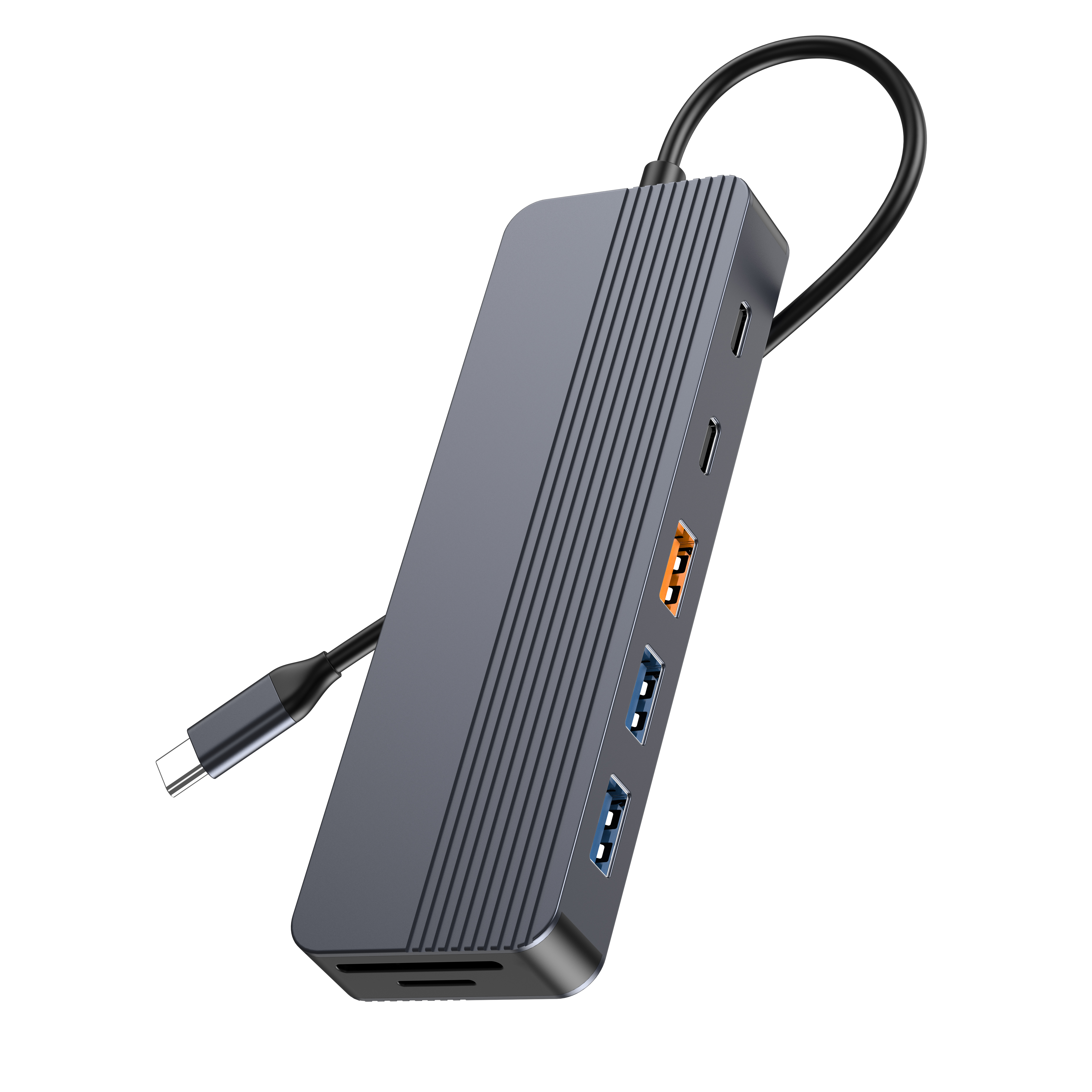
You must carefully align your hardware design with actual user habits. Defining your precise USB C card reader hub specifications prevents unnecessary performance compromises. A successful build requires attention to internal silicon and external structural elements.
Start by outlining your optimal port configuration strategy. Conduct a thorough internal hardware audit across your departments. Determine exactly which interfaces your team uses daily. You might only need dual SD slots, two high-speed Type-C data ports, and Gigabit Ethernet. Drop the HDMI or VGA ports if you deploy the devices strictly for file management. This targeted approach reduces overall PCB complexity and minimizes manufacturing costs.
Procurement managers must confidently justify custom manufacturing runs to internal stakeholders. You have to balance upfront tooling investments against long-term hardware reliability. Navigating this financial equation requires a clear understanding of manufacturing dynamics.
Understanding Minimum Order Quantities (MOQs) sets realistic budgetary expectations. Factories cannot spin up dedicated assembly lines for ten units. A baseline MOQ typically ranges from 500 to 2,000 units. Simple cosmetic branding requires much lower minimums. Complex PCB redesigns or unique tooling molds push the MOQ significantly higher. You must evaluate if your planned deployment scale justifies these required volume thresholds.
Next, carefully analyze the unit cost versus long-term replacement expenses. Custom prototypes and injection molding fees increase your initial capital expenditure. However, you must calculate the hidden financial drain of generic hardware. Standard units often fail within months under heavy corporate use. You spend significant time and money constantly replacing broken off-the-shelf hubs. Customizing port layouts eliminates unused, fragile failure points. Upgraded thermal designs extend the hardware lifespan significantly, yielding a better return on investment over a three-year cycle.
Factoring in manufacturing lead times heavily influences your deployment schedules. You can buy generic hubs online and receive them tomorrow. Custom manufacturing follows a strict, multi-step production timeline. You must account for engineering delays and freight logistics. You have to plan corporate rollouts well in advance to accommodate these manufacturing windows.
| Production Phase | Typical Timeline | Key Milestones |
|---|---|---|
| Engineering & CAD | 1 - 2 Weeks | PCB layout approval, enclosure design, LUN specification. |
| Prototyping & Testing | 2 - 3 Weeks | Functional sample creation, thermal testing, bandwidth verification. |
| Mass Production | 3 - 4 Weeks | Component sourcing, SMT assembly, QC testing, packaging. |
| Shipping & Logistics | 1 - 3 Weeks | Air or sea freight, customs clearance, final warehouse delivery. |
Your custom hardware is only as reliable as the factory producing it. Finding a trustworthy USB C card reader hub supplier requires careful, methodical vetting. A flashy website does not guarantee capable engineering.
Choosing between generic and customized hardware actively shapes your daily operational efficiency. Customization becomes mandatory when you handle high-demand workflow optimizations. It solves strict corporate security protocols and elevates high-volume branded deployments. Standard off-the-shelf devices only suffice for temporary needs or low-intensity desk setups. You secure better performance, stable data transfers, and extended hardware longevity by tailoring the specifications directly to your team.
Take immediate action by auditing your team's daily connectivity habits. Document your required port configurations and baseline data transfer speeds. Calculate your desired unit volume based on upcoming quarterly deployments. Armed with these precise details, you can request accurate initial RFQs (Requests for Quote) from vetted manufacturers to begin the prototyping process.
A: MOQs depend heavily on the depth of customization requested. Simple cosmetic changes like laser-engraved logos typically require an MOQ of 500 units. Full structural changes, custom PCB layouts, or specific chipset requests usually push the MOQ to 1,000 or 2,000 units to cover initial tooling and engineering costs.
A: Yes, but only if engineered correctly. Standard hubs often use single-LUN chipsets that force cards to share a connection. You must explicitly specify a dual-LUN (Logical Unit Number) controller during the design phase to enable simultaneous, high-speed mounting and data transfers.
A: The timeline typically spans six to eight weeks. CAD design and PCB prototyping take roughly two weeks. After you approve the physical sample, mass production requires another three to four weeks. Finally, freight shipping and customs clearance add one to three weeks depending on your location.
A: Modification invalidates standard certifications if you alter the internal PCB or power delivery pathways. However, a reputable supplier will submit the new custom product for mandatory recertification. They ensure the final batch complies fully with regional CE, FCC, and RoHS standards before shipment.


