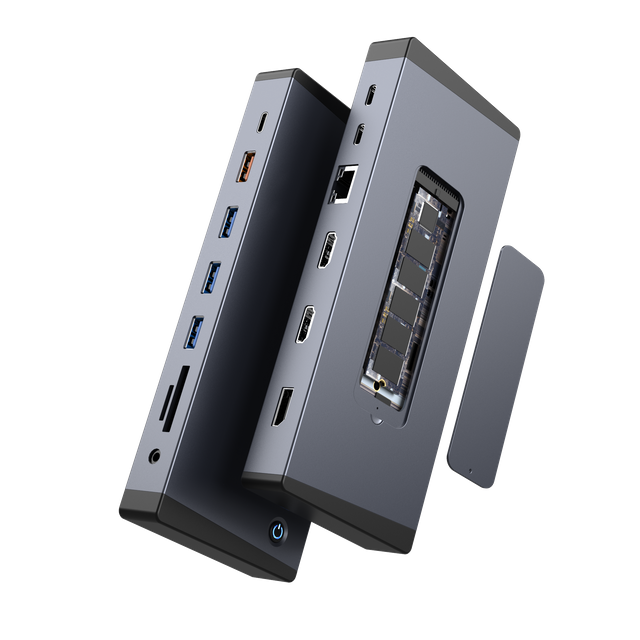
Docking stations often generate the highest volume of IT support tickets in mixed-device environments. Employees plug in their laptops, only to face flickering monitors, unrecognized peripherals, or network dropouts. These daily frustrations waste valuable time. They drain your helpdesk resources and severely impact user productivity.
Transitioning from fragmented, consumer-grade hubs to a standardized strategy changes this dynamic. A unified approach reduces IT overhead while ensuring reliable daily operations. You move away from buying random adapters. Instead, you build a resilient endpoint infrastructure. This structured approach guarantees user productivity across the entire office.
In this guide, we will explore how to evaluate critical dock features for your organization. We will help you manage common rollout risks effectively. You will also learn how to establish a bulletproof procurement framework for corporate fleets. By understanding these technical elements, you can stop troubleshooting hubs and start enabling your workforce.
Key Takeaways
- Manageability is mandatory: True enterprise docks support remote firmware updates, PXE boot, and MAC Address Pass-Through.
- Universal vs. OEM requires trade-offs: Standardizing on Universal (DisplayLink) vs. OEM enterprise docking depends heavily on your fleet's hardware homogenization.
- Power and bandwidth dictate lifespan: Over-provisioning Power Delivery (PD) and bandwidth (e.g., standardizing on a Thunderbolt 4 dock) prevents early obsolescence.
- Pilot testing reduces rollout risk: Physical durability, thermal limits, and cross-OS compatibility must be validated in the actual environment before mass procurement.
Consumer vs. Enterprise Docking Stations: The Defining Line
You can easily spot a consumer dock on a retail shelf. Manufacturers highlight high port counts and flashy designs. They focus entirely on individual convenience. The business problem demands a completely different approach. Enterprise hardware prioritizes fleet security, remote management, and network identity. IT departments need control, visibility, and standardized behavior across hundreds of desks.
A basic USB-C hub might work fine in a home office. However, deploying them at scale introduces massive security and maintenance blind spots. You need hardware designed for corporate environments. Choosing the right Enterprise Docking Station requires looking past the physical ports. You must evaluate the underlying firmware and network capabilities.
Network Passthrough & Security
Corporate network environments require strict device authentication. When users connect through a generic dock, the network sees the dock's MAC address. This creates a massive security loophole. It ruins DHCP logging and breaks endpoint security policies. MAC Address Pass-Through solves this problem. It allows the dock to transmit the laptop's unique MAC address to the network. Your security tools recognize the actual host machine, not the intermediary device.
Furthermore, IT teams rely on automated overnight processes. You cannot rely on users leaving laptops open and powered on. PXE Boot (Preboot Execution Environment) allows network administrators to boot machines remotely. You can image OS updates or deploy critical patches silently. Coupled with Wake-on-LAN (WoL), these protocols ensure your fleet remains secure without disrupting daytime workflows.
Physical Security Elements
Device theft remains a genuine concern in shared office spaces. Docks are easily pocketable items. Enterprise models include Kensington lock slots to secure the hardware directly to the desk. You also want to consider desk organization. VESA mount compatibility allows you to attach the dock behind monitors. This creates clean desks and prevents tampering. Finally, tamper-resistant host cables ensure users do not swap or damage the critical link between the laptop and the dock.
Core Evaluation Criteria for Corporate Dock Deployment
Power Delivery (PD) Capabilities & High-Load Limits
Power Delivery determines whether a laptop slowly discharges under load or stays reliably charged. You must assess base requirements first. Standard ultrabooks generally require 60W to 90W of power. Most enterprise docks handle this easily. However, modern fleets rarely consist of just basic laptops.
High-end engineering and workstation laptops push these limits quickly. A standard 90W dock might cause severe thermal throttling. Heavy GPU or CPU loads drain the battery faster than the dock can charge it. For power users, you need robust solutions. Consider units delivering 130W or more. In extreme cases, split-power solutions become necessary. Over-provisioning power upfront prevents unexpected hardware slowdowns down the line.
Display Protocols and Mixed Environment Realities
Display support often causes the most frustration. You must evaluate DisplayPort Alt Mode against DisplayLink technology. DisplayPort Alt Mode uses the laptop's native GPU to drive external monitors. It works seamlessly for Windows machines with appropriate ports. However, mixed OS fleets introduce critical differences.
Apple M-series laptops present a unique challenge. Base M1, M2, and M3 chips natively support only one external monitor. Connecting a standard DP Alt Mode dock leaves users with mirrored screens. DisplayLink technology bypasses this native limitation. It uses software-driven graphics processing to enable dual or triple displays. For mixed environments, DisplayLink acts as a universal equalizer.
Bandwidth Future-Proofing (Thunderbolt 4 vs. USB-C)
Bandwidth dictates device lifespan. You must evaluate the technical thresholds carefully. Standard USB-C 3.2 hubs split bandwidth strictly between video and data lanes. If you run dual 4K monitors, your USB transfer speeds plummet. Deploying a high-end Thunderbolt 4 dock eliminates this bottleneck entirely.
Thunderbolt 4 offers 40 Gbps of dynamic bandwidth allocation. It intelligently shifts resources between high-resolution displays, gigabit ethernet, and fast storage arrays. This standard also guarantees backward compatibility. A TB4 dock steps down gracefully to support older USB-C laptops in your fleet. You ensure premium performance for new machines while maintaining basic functionality for older models.
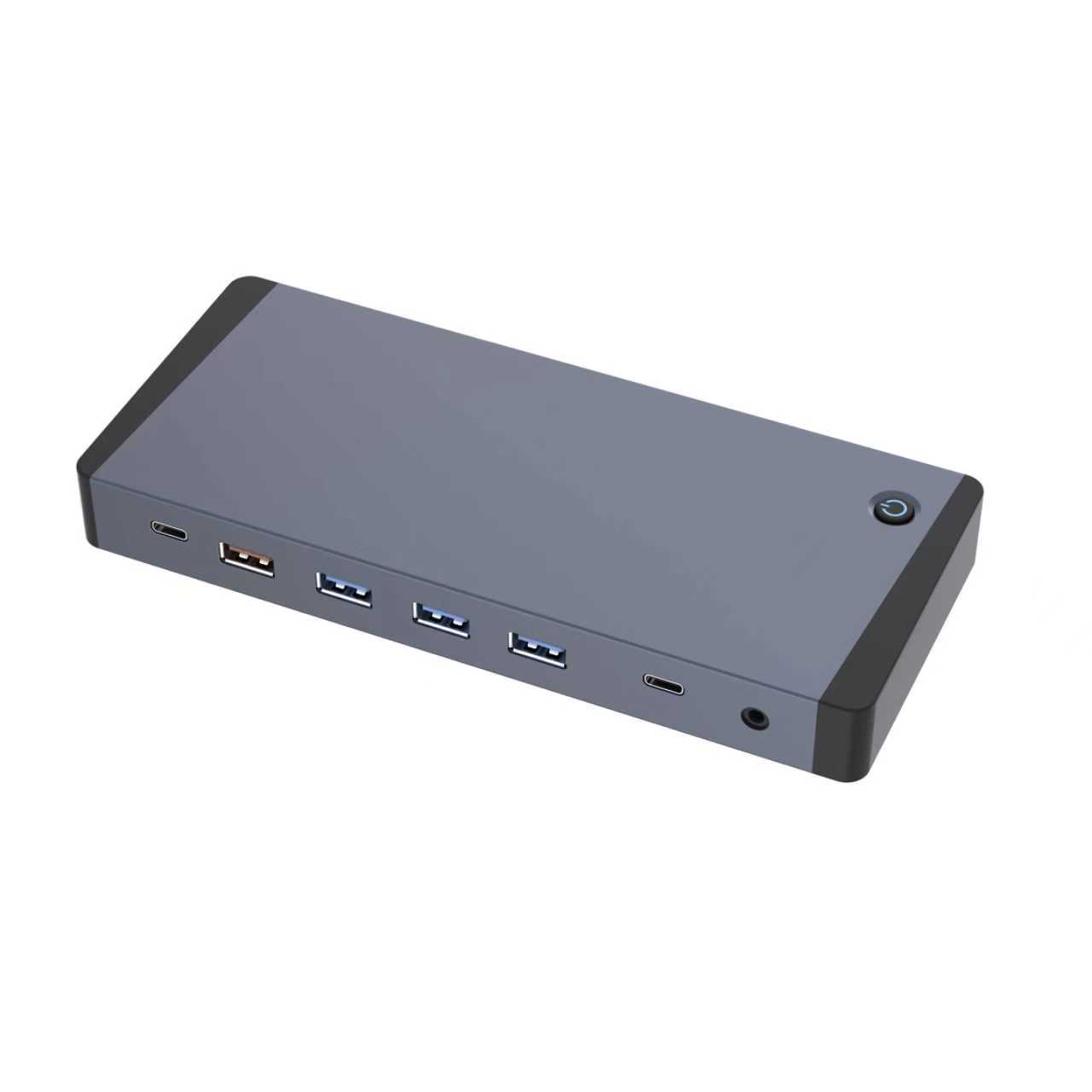
OEM Enterprise Docking vs. Universal Solutions
Choosing between proprietary models and universal brands defines your entire hardware strategy. Each path carries specific advantages and significant drawbacks. Your decision depends entirely on your current hardware homogenization and future procurement plans.
Below is a quick comparison chart detailing the differences between the two primary deployment routes.
| Deployment Route | Primary Advantages | Potential Drawbacks |
| OEM Route (Dell, HP, Lenovo) | Deep BIOS integration, single-vendor warranty, streamlined updates. | Vendor lock-in, compatibility friction with other laptop brands. |
| Universal Route (Plugable, Targus, Independent) | Maximum flexibility, ideal for BYOD, often highly cost-effective. | Requires third-party drivers, complex automated bulk updates. |
The OEM route offers unmatched synergy for single-vendor environments. Companies like Dell, HP, or Lenovo build docks to communicate deeply with their own laptops. You get seamless BIOS integration. Single-vendor warranty support simplifies RMAs. Furthermore, proprietary update tools make pushing firmware patches practically invisible. However, this route creates heavy vendor lock-in. If your organization decides to switch laptop brands next year, you might face significant compatibility issues.
The universal route focuses on brand agnosticism. Independent brands build hardware to work across the board. You gain ultimate flexibility in BYOD or mixed-hardware environments. Choosing an OEM enterprise docking manufacturer who supports universal standards often proves more cost-effective. The downside involves software reliance. Universal docks often require third-party drivers like DisplayLink. You might also experience friction when using endpoint management tools (SCCM/Intune) to push bulk firmware updates.
Implementation Risks and Fleet Management Realities
Procuring the hardware only represents the first step. The real challenges emerge during active deployment and daily use. Managing a large-scale endpoint environment requires anticipating physical wear and software drift. You must recognize these fleet management realities to prevent widespread system failures.
Firmware Management Nightmares
Manual dock updates carry massive hidden costs. Imagine asking support technicians to visit 500 desks individually to flash dock firmware. It is an impossible, expensive task. Unpatched docks cause sudden peripheral disconnects and screen flickering. You must evaluate docks based on their management software. Enterprise models support silent, background firmware deployment. They allow you to push MSI installer packages via standard endpoint management systems like Intune. This keeps the fleet stable without user intervention.
Cable Degradation and Replaceability
The host connection cable takes the most physical abuse. Users yank, twist, and crush these cables daily. Unsurprisingly, the host cable is the highest failure point in any docking setup. Docks featuring hardwired host cables increase your total replacement costs dramatically. If the cable breaks, you throw away the entire dock. Modular, verifiable active cables solve this issue. You simply replace a broken cable for a fraction of the cost, keeping the main unit in service.
Thermal Management
Hot-desking environments demand constant hardware endurance. Consumer docks easily overheat when pushed hard for several hours. Enterprise models require superior passive cooling mechanisms. They must survive 24/7 operation in poorly ventilated office enclosures. Poor thermal management leads directly to dropped peripheral connections and frozen ethernet ports. A successful corporate dock deployment mandates hardware built to dissipate heat efficiently under continuous load.
Shortlisting Logic: Building Your Deployment Checklist
Do not guess what your users need. A structured shortlisting process prevents costly procurement mistakes. You must gather concrete data before engaging vendors. By building a systematic checklist, you guarantee the chosen hardware aligns with actual daily usage.
- Audit the Current Fleet: You must document your exact environment. Record the OS breakdown between Windows, Mac, and Linux. Identify the interface generations currently in use, mapping out TB3, TB4, and standard USB-C ports. Finally, define baseline display needs. Determine who requires dual 1080p monitors versus those needing dual 4K setups.
- Define the Standard Configurations: Never let users buy their own adapters. Reduce SKU sprawl immediately. Select one standard model for general office users. Choose one robust, high-performance model for power users and engineers. A standardized enterprise laptop docking station strategy simplifies helpdesk troubleshooting immensely.
- Execute a Proof of Concept (PoC): Physical testing proves theoretical compatibility. Deploy test units to a small group of harsh critics.
- Test sleep/wake cycles thoroughly with multiple monitors. This remains a notorious point of failure.
- Verify network connectivity stability during long video conferencing sessions.
- Test peripheral compatibility aggressively. Ensure specialized HID devices, headsets, and webcams wake up correctly every time.
Conclusion
The modern workplace demands a fundamental shift in IT strategy. You can no longer view docking stations as simple desktop accessories. They act as critical IT infrastructure bridging the gap between mobility and productivity. Treating them as vital network nodes prevents endless helpdesk tickets and frustrated users.
Successful corporate deployments always balance upfront hardware costs against long-term IT support hours. Over-provisioning power and bandwidth now prevents mass replacements next year. Prioritizing management features like PXE boot and silent firmware updates keeps your team focused on larger initiatives.
Your next steps are clear. Evaluate your current fleet matrix thoroughly. Document your operating systems, interface ports, and power requirements. Then, reach out to trusted hardware vendors and request evaluation units. Run a rigorous proof of concept before signing any bulk purchase orders. Proper planning ensures a flawless rollout.
FAQ
Q: Can a Thunderbolt 4 dock work with a standard USB-C laptop?
A: Yes. Thunderbolt 4 features excellent backward compatibility. If you connect a standard USB-C laptop, the dock automatically steps down its performance to match the host device. However, you will experience feature degradation. Data transfer speeds will drop, and you may face limitations regarding dual monitor support and maximum display resolutions.
Q: Why do MacBooks in our fleet only extend to one external monitor through the dock?
A: macOS does not support Multi-Stream Transport (MST) natively over standard DisplayPort Alt Mode. Base Apple M-series chips (M1, M2, M3) physically restrict external display output to a single screen. To bypass this, you must deploy docks equipped with DisplayLink chipsets. DisplayLink uses software drivers to enable dual or triple displays on these machines.
Q: How do we update docking station firmware across 1,000+ remote employees?
A: You need enterprise-grade hardware designed for remote management. Look for manufacturers providing silent MSI installer packages. IT administrators can deploy these packages via standard endpoint management systems like Intune or SCCM. This enables background firmware flashes without requiring any user interaction or physical desk visits.
Q: Is an OEM enterprise docking station always better than third-party options?
A: Not necessarily. OEM models work best in highly homogenous, single-brand environments, offering deep BIOS integration and unified warranties. However, they can severely restrict flexibility in mixed-device or Bring Your Own Device (BYOD) environments. Universal third-party docks often provide broader compatibility across varied laptop brands and operating systems.