One supplier quotes $22 per USB-C dock. Another quotes $27. The model on both quotes is the same. Which offer would you take?
The $22 quote includes the dock and host cable in bulk packaging. The $27 quote includes an approved power adapter and mains lead, your branding, a retail box and a quick-start guide. It also lists a separate artwork setup fee. The two suppliers are pricing different things. If your job is to put a ready-to-sell kit on a shelf, you still have several purchases to make after accepting the first quote.
These are illustrative figures, not Yuanshan prices. They show how to compare OEM USB-C docking station quotes before placing a first order. Start with what your customer expects to receive, calculate the cost of reaching that same point with each offer, then ask for a written quote that makes the difference visible.
Put the two quotes side by side
Assume you need 500 branded kits and your customer expects a power adapter in every box. Both offers include the same dock hardware and the same host cable. Both are in US dollars. Here is what each supplier has priced:
| At 500 kits | Quote A | Quote B |
| Dock and host cable | Included | Included |
| Approved adapter and required mains lead | Excluded | Included |
| Dock branding, retail box and quick-start guide | Excluded | Included |
| Packing the final retail kit | Buyer arranges separately | Included |
| Quoted price per unit | $22.00 | $27.00 |
| Separately billed artwork setup | None for the unbranded offer | $150 |
![Yuanshan X760 docking station port layout]()
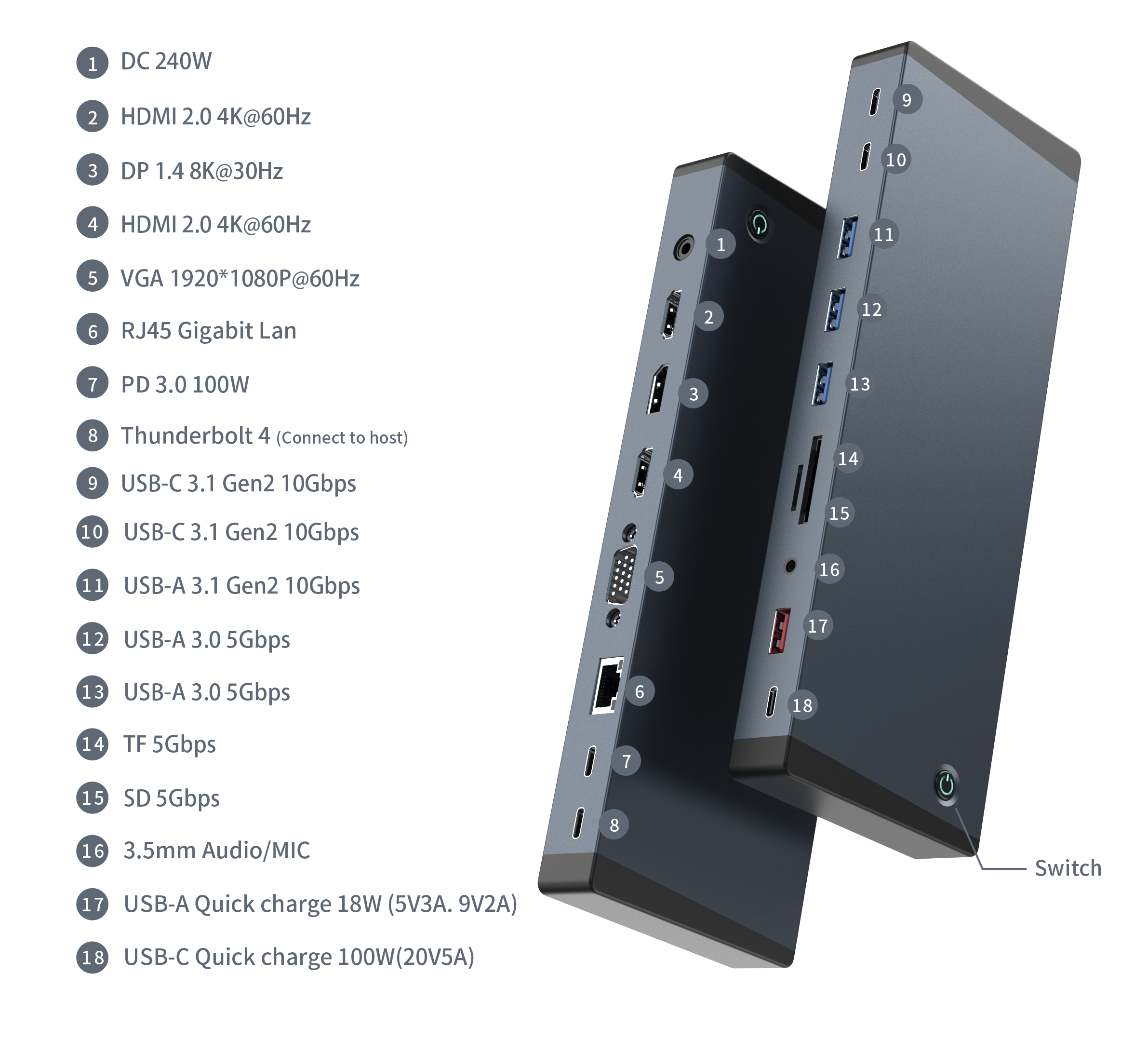
Yuanshan X760 port layout. The example prices above are hypothetical and do not apply to this model.
If you choose A, suppose you pay $3.50 per kit for the approved adapter and mains lead, $1.50 for branding and printed materials, and $0.80 to finish packing. That brings the example to $27.80 per finished kit, or $13,900 for 500. With B, the $150 setup fee adds $0.30 per kit to the first order. That brings it to $27.30 per finished kit, or $13,650. The quote that looked $5 cheaper comes out $250 higher on this order once both offers provide the same kit.
This calculation stops at the packed kit. It leaves out shipping, import charges and any other cost that has yet to be compared. If the two offers use different shipping terms, get the price to the same named destination before deciding. Ask which setup charges recur on a reorder, too. A cost spread across the first 500 units may disappear from the next purchase or come back when you change the artwork.
There is also a good reason to choose the simpler offer: you may already have the approved power supplies and packaging, or your customer may be buying for a deployment that provides its own power. If so, ask each supplier to price that version. The aim is to buy the kit your customer needs and see what each choice costs.
Write down what your customer expects in the box
Start with one sentence your sales team can put on the offer: “Each kit includes the dock, host cable, approved power adapter and mains lead, branded retail box and English quick-start guide.” If your buyer expects something different, change the sentence before you send it to manufacturers. “Standard packaging” and “adapter optional” make sense on a catalog page. They leave too much room for interpretation on an order.
Ask suppliers to identify the actual model, included cable and approved power supply where applicable. “Same shell” tells you little about whether the hardware inside is the same or whether it does what the original sample did. If two offers use different revisions or accessory part numbers, have the suppliers say what changed and whether the sample covers it. Our OEM docking station specification sheet guide helps turn the customer's use case into fields you can send with the quote request.
The adapter can also affect which features a customer can use. On Yuanshan's X760, for example, the dedicated USB-A and USB-C accessory charging outlets require the specified 240 W DC supply. Powering the dock through its USB-C PD input does not enable those two outlets. If they are part of your sales offer, ask the supplier to spell out the approved power setup and whether the adapter is included, quoted separately or supplied by you. See what works in each X760 power mode. The prices above are for a hypothetical order, not for the X760.
The same principle applies to branding. A quote that includes your logo on the dock may still exclude the printed box or setup guide. If two versions share the same dock but ship with different contents, give each a name that stays consistent from the quote through to the order confirmation. Our APEC article on launching one dock in two markets explains how to decide what you can share across markets. This step gives each version its own price.
Look for the costs that sit outside the unit price
Once both suppliers have the same contents list, ask them to separate the following items. A blank line means you still have a question to ask; it does not mean the item is included or free.
Per-kit items: dock, cable, power parts, logo application, retail box, inserts and final packing. Ask which are included and which are separately priced.
First-order or one-time charges: samples, artwork setup, printing plates or tooling where applicable. Ask when each fee applies and what triggers another charge.
Freight and handover: quote currency, the named shipping point or destination, and what shipping costs are included. Compare both offers to the same point.
Order limits and dates: minimum quantity for the specific build, quantities for each box or artwork version, time to sample, and when the production lead time starts.
For example, the dock might be available in your proposed first-order quantity while the printed box has a larger minimum. Ask what happens to the remaining boxes if you pay for more than you use on the first shipment. Ask who stores them, how you can use them on a reorder and what changes if your branding is revised. Our guide to custom USB-C hub packaging goes into the packaging choices. The commercial question here is what you pay for now and what you can use later.
Check the dates against your launch. “Four weeks” might mean four weeks from the order, from approval of the sample or from the final artwork sign-off. Ask the supplier to write the starting event and the milestone that ends the period. If one price gets you a finished kit in time and the other leaves you to source a cord or approve a box separately, the two offers have different launch schedules. See how MOQ and lead time affect docking station procurement if you are weighing first-order volume against delivery.
Get the first-order total and the reorder price in separate lines. In the 500-kit example, if the artwork and prices stay the same and B's setup fee is genuinely one-time, the next order from B would cost $13,500 before shipping, rather than $13,650. That is a useful distinction for a distributor planning regular replenishment. It is also a reason to ask whether new artwork, a different box language or a different sales channel would bring the charge back.
Give both suppliers a chance to correct your comparison before you decide. Mark each unconfirmed item as “please confirm,” then send the same list back to both. When an option is excluded, ask for an add-on price or note what you would pay separately. When the delivery point differs, keep those prices out of the same total until you can compare them fairly. Save the dated version you accepted so the next order starts with the actual configuration, even if someone else takes over the account.
Ask for two options when you have not decided what to include
You do not need to settle every detail before you start a conversation. Suppose your reseller wants an install-ready kit, but your online channel may prefer to leave the adapter out. Ask one supplier to quote the same hardware and artwork at the same quantity, then show the price with and without the approved adapter and mains lead. Keep everything else fixed. You get the cost of that choice without having to work backward from two unrelated quotes.
Use the same approach if you are deciding between a plain box and branded retail packaging. If the customized box affects the minimum, setup cost or approval time, ask the supplier to show that next to the price. You can then decide whether to use it on day one or after the first order. If the proposed kit is for a distributor with several destination markets, ask for each contents variation on a separate line so the quote can be matched to the final order.
Before ordering in volume, have the manufacturer identify which parts your sample represents. A stock sample can establish the dock's fit with your laptop. A packaging proof can show branding and instructions. If the final offer promises a power supply and accessories in every retail box, ask how that complete kit will be approved before release. Put the sample reference and contents list on the quote or order acknowledgement so your buyer and supplier are comparing the same thing.
Request a quote you can compare
Send Yuanshan three things to get started: the dock model or the job it needs to do, what must be in the box, and your estimated first-order quantity. Add the destination market; a launch date is helpful if you have one. You can copy this and fill in what you know:
We're sourcing a private-label USB-C docking station for [market and sales channel]. Our customers need [main laptop, display or network setup], and our first order is approximately [quantity]. Please quote the dock with [host cable, own branding, retail box and quick-start guide], with and without the approved power adapter and mains lead if both options fit our project. Please list one-time charges, the minimum order for each option and the sample and production lead times separately.
Request a like-for-like dock quote from Yuanshan →
If you have not chosen a model, send your intended setup or a link to the product you want to replace. Ask us to suggest a starting configuration and identify what would change the kit price. Your first conversation can start with a short message, and the quote can spell out what your customers will actually receive.